
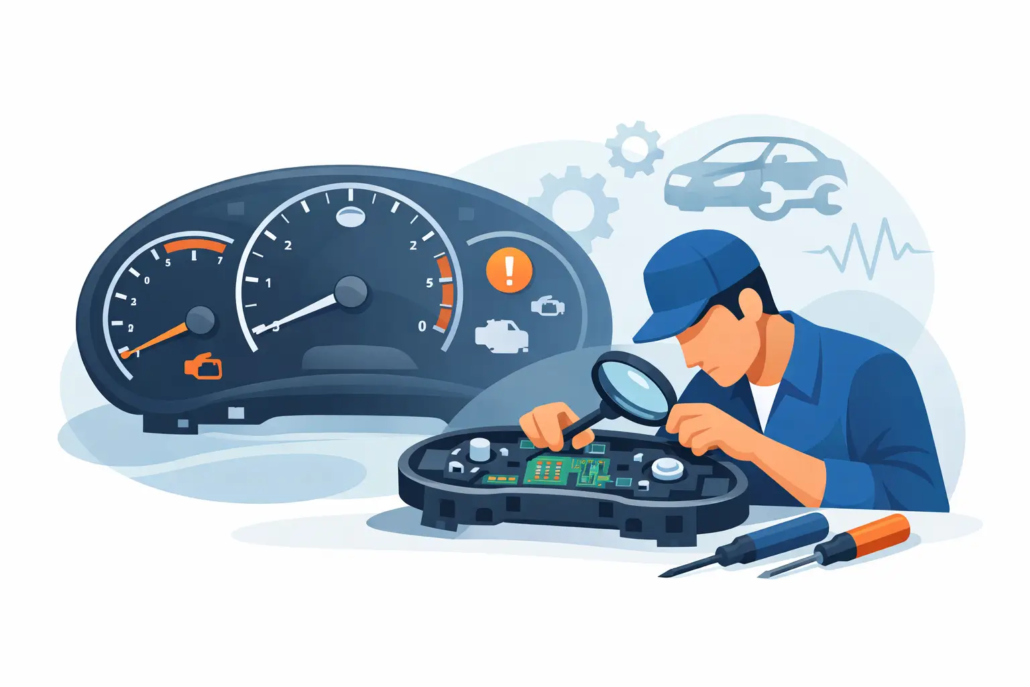
What Is Instrument Cluster Repair?
A flickering dashboard, dead speedometer or missing pixels on the display is more than an irritation. It can leave you without vital information every time you drive. If you have been asking what is instrument cluster repair, the simple answer is this: it is the specialist process of diagnosing and fixing faults within the dashboard cluster so the original unit works properly again.
For most drivers, the instrument cluster is the part of the dashboard that shows speed, revs, fuel level, warning lights, mileage and vehicle information. In many modern vehicles, it is also tied into coding, immobiliser data and communications with other control units. That is why cluster faults are not usually a simple matter of swapping a bulb or replacing a fuse and hoping for the best.
What is instrument cluster repair and what does it cover?
Instrument cluster repair means restoring the original dashboard unit by identifying the failed components, testing the circuitry and correcting the fault. Depending on the vehicle and the problem, that can involve repairing the power supply section, replacing failed motors or regulators, restoring dim or dead backlighting, fixing LCD or pixel display faults, and resolving gauge or warning light failures.
The key point is that a proper repair focuses on the actual cause of the fault, not just the symptom. If a display is blank, for example, the issue might be the screen itself, a poor solder connection, a failed internal component or a communication problem inside the cluster. A specialist repair process separates those possibilities rather than guessing.
That matters because modern clusters are not generic plug-in parts. They often store mileage, configuration and security data. Replacing them can mean extra coding, mismatch problems and higher cost. Repairing the original unit avoids many of those issues.
Common signs your instrument cluster needs repair
Some faults are obvious from the moment you start the car. Others appear intermittently and get worse over time. The most common signs include gauges that stop working, warning lights that are too dim or stay off completely, a speedometer or rev counter that behaves erratically, and centre displays that lose lines, pixels or full sections of information.
You may also see the cluster go completely dead, reset itself while driving or show incorrect readings. On certain vehicles, the fault can affect communication with diagnostic equipment or trigger multiple warning messages even though the underlying issue sits inside the dashboard itself.
Intermittent faults are especially common. A cluster may work perfectly when cold, then fail as it warms up. It may come back to life after a bump in the road or after the battery has been disconnected. That does not mean the fault has gone away. It usually means an internal electronic issue is developing.
Why instrument clusters fail
Instrument clusters fail for several reasons, and age is only one of them. Heat cycles, vibration and regular use all take their toll on electronic components. Solder joints can crack, internal voltage regulators can fail and display connections can degrade over time.
Some faults are make and model specific. Certain vehicles are known for pixel loss, others for dead gauges or complete power failure. In these cases, a specialist familiar with common platform faults can usually identify the likely cause quickly.
Electrical events can also play a part. Low voltage, jump-starting issues, charging faults or water ingress may damage sensitive electronics inside the cluster. That is one reason general garage checks do not always solve the problem. The issue may sit inside the unit itself rather than elsewhere in the car.
Repair or replacement – which makes more sense?
In many cases, repair is the better option. A brand new cluster from a main dealer is often expensive, and that is before fitting, coding and setup are added. It can also introduce delays if the part is not in stock or needs ordering from overseas.
Repairing the original unit is usually faster and more economical. It also keeps the original mileage and coding with the vehicle, which is a major advantage. There is no need to start introducing second-hand parts of unknown history or risk compatibility problems with a replacement unit.
That said, it depends on the condition of the cluster. If the unit has severe physical damage, fire damage or previous poor-quality repair work, replacement may sometimes be the only practical route. A proper diagnosis is what tells you which option makes sense.
What happens during an instrument cluster repair?
A proper repair starts with fault confirmation. The unit is assessed against the reported symptoms, then tested using specialist equipment. In a serious electronics workshop, that may include emulator testing to simulate vehicle signals and prove whether the cluster responds correctly outside the car.
Once the fault is located, failed components are repaired or replaced. That might involve precision soldering, circuit board repair, motor replacement, display restoration or power supply repair. The unit is then retested to make sure the original fault has been resolved and that the cluster performs as it should.
The best repair services do not rely on trial and error. They work from known fault patterns, measured test results and experience with specific vehicle platforms. That is what separates a specialist repair from a general electrical guess.
Is instrument cluster repair safe for mileage and coding?
This is one of the biggest concerns for vehicle owners and garages, and rightly so. The short answer is yes – when the original unit is properly repaired, the existing mileage and coding are normally retained because the cluster itself remains the same unit.
That is a major benefit of repair over replacement. With a replacement cluster, extra steps are often needed to align coding, synchronise vehicle data or adapt the unit to the car. With the original cluster, those complications are usually avoided.
For customers, that means less risk of mismatch issues and less chance of ending up with a vehicle off the road while someone tries to resolve coding problems. For trade customers, it means a more straightforward job and a cleaner handover back to the customer.
Who needs specialist instrument cluster repair?
This service is relevant to more people than many realise. Private motorists often notice the problem first when they cannot read speed, fuel level or warning messages properly. Van owners and motorhome owners rely heavily on working dashboard information too, especially on longer journeys.
For independent garages and dealerships, cluster faults can be awkward jobs. The symptoms may look electrical, but general workshop testing does not always pinpoint the root cause. Sending the unit to a specialist is often the fastest way to get a clear answer and a reliable repair.
That is where a dedicated service becomes valuable. A specialist such as Cartronix can test, repair and return original instrument clusters quickly, whether the job comes in by post from anywhere in the UK or through a booked workshop appointment.
How long does instrument cluster repair take?
Turnaround depends on the vehicle, the fault and parts availability, but instrument cluster repair is often much quicker than dealer replacement. For common faults on known units, same-day or next-working-day turnaround is often possible.
That speed matters if the vehicle is needed for work, family use or a booked workshop slot. It also helps garages keep jobs moving rather than tying up ramps and waiting on dealer parts.
If a unit has uncommon faults or previous repair attempts that have caused extra damage, it can take longer. Even then, a specialist repair route is usually still more efficient than starting from scratch with a replacement cluster and coding process.
When should you get it checked?
As soon as the fault starts affecting visibility, warning lights, gauge accuracy or overall reliability, it is worth having it looked at. Waiting rarely improves anything. A flickering display or intermittent gauge issue may still allow the vehicle to be driven, but these faults tend to worsen and can eventually lead to complete failure.
Early diagnosis also helps avoid unnecessary parts replacement elsewhere. If the issue is inside the cluster, replacing sensors or chasing wiring faults without proper evidence only adds cost and delay.
A good repair service should be clear about what it can test, what faults it commonly sees and whether the unit is repairable before unnecessary expense builds up.
Instrument cluster repair is not about patching over a nuisance. It is about restoring the dashboard electronics your vehicle relies on every time you drive, without dealer replacement costs and without losing the originality of the unit. If your gauges, display or warning lights are no longer doing their job, getting the original cluster properly repaired is often the quickest route back to a vehicle you can trust.

